

Pentru că matematica de nivelul filologiei a devenit mult prea simplă – cum ar spune domnul profesor, este o jucărie – nefiindu-ne îndeajuns, ne-am gândit să ne îndeletnicim cu chineza pură, cu deslușirea mesajelor, a cuvintelor, chiar și a tonalității orale ce stau adăpostite sub acoperișul liniuțelor și căsuțelor ortografice.
Cursul de chineză semnifică o materie suplimentară, complexă și destinată elevilor care doresc să învețe o limbă străină ieșită din tiparele latinești. Aceasta se desfășoară o dată pe săptămână, miercurea, în clasa a XI-a C, de la ora 14 la ora 15. Profesoara de limba chineză, doamna Caixia Wang, predă într-un mod interactiv, făcând loc explorării și entuziasmului, atingând scopul de a lărgi orizontul lingvistic și cultural al liceenilor. Deocamdată, studiem temeiul susurelor mandarine: cuvinte, litere, pronunția sunetelor, pronume personale, substantive și structura propozițiilor – tematica gramaticii.
Țesând o legătură amicală, mai profundă, cu doamna profesoară, prin demolarea zidurilor ridicate de graiuri până atunci complet înstrăinate unul de celălalt, am reușit să o cunoaștem mai bine, să trecem dincolo de identitatea ei „de suprafață”. Astfel, ne-am permis să îi adresăm câteva întrebări deschise.

Lăsăm aici interviul care s-a cristalizat, unind curiozitățile noastre cu răspunsurile dumneaei.
What motivated you to teach the Chinese language in a Romanian school here in Oradea?
Honestly, before coming to Romania, I wasn’t sure which city I would be assigned to. When I was teaching at a university in China, I had four Romanian students in my class and also got to know other Romanian students. I was deeply impressed by their friendliness, politeness, and their eagerness and intelligence in learning. Through our interactions in and out of class, I also got a sense of the simplicity of life and the rich, fascinating cultural diversity in Romania, which filled me with curiosity and a sense of longing for this country. So when the opportunity arose to teach abroad, I chose Romania and was fortunate to be assigned to the beautiful city of Oradea.
As for why it was Oradea—I believe it was all about fate. A beautiful twist of fate brought us together unexpectedly.
In the upcoming classes, will we also explore Chinese literature or at least discuss some key narratives originating from China?
As a Chinese language teacher, my primary task is to help everyone master the Chinese language. Language is a carrier of culture; each language reflects a different way of thinking and aesthetic perspective. Only by mastering the language can one gain a deeper understanding of the cultural meanings behind it.
In the early stages of language learning, we mainly focus on pronunciation, basic expressions, and daily life habits. However, even in the beginner stages, we incorporate the recitation of classical poetry to give everyone an experience of the rhythm and cadence of Chinese poetry. More systematic literary content is typically introduced in the intermediate and advanced stages.
If students are interested, I would be very happy to offer special sessions on Chinese literature in English—such as exploring the <Analects of Confucius> or classical Chinese poetry—and guide everyone in uncovering the wisdom and beauty within these works.
How do you perceive the cultural transition between Chinese and Romanian traditions?
The key is to maintain an open mind—sincerely respect differences, accept diversity, and be willing to learn. Although our cultural backgrounds differ, we share the same human nature. On the basis of mutual respect, we can seek common ground while accepting differences. Through mutual learning and understanding, we can gradually achieve a natural transition between the original culture and the local one.
Do you believe that students from Ghibu have the potential to effectively assimilate linguistic differences? If so, from what perspective do you hold this belief, and what have you observed about us as students so far?
Without a doubt, the students at Ghibu possess all the necessary potential to effectively adapt to linguistic differences. My confidence in you stems from several key observations. You have already demonstrated this capacity in many ways.
Firstly, “Onisifor Ghibu” as one of the leading schools in Bihor County, provides a uniquely fertile ground for growth with its advanced educational philosophy, international outlook, and core values such as innovation, tolerance, responsibility, and respect. This nurturing environment inherently equips students with the openness needed for such challenges.
Secondly, although our time together has been less than three weeks, I have been genuinely touched by the kindness and curiosity you’ve shown me. From your warm greetings in the hallways to the insightful questions you ask in class, you consistently demonstrate an open mind and a respectful attitude—which are the very cornerstones of overcoming language barriers. I have also been deeply impressed by your active participation and sharp intellect in class; your enthusiasm and capabilities make me truly believe in your potential.
In your opinion, where is it more challenging to be a teacher – in China or in Romania? And why?
As a foreign language teacher, teaching itself poses certain challenges in both China and Romania.
In China, I mainly taught international university students. Although they were close in age, their linguistic backgrounds, cultural habits, motivations, and proficiency levels varied greatly. Balancing these diversities in the classroom was a challenge for me. That said, studying Chinese in China offers a natural language environment and sufficient class hours, which greatly benefits language acquisition.
In Romania, students vary more in age, ways of thinking, and learning styles. Combined with the lack of a natural Chinese-speaking environment and limited class time, I need to constantly adapt my teaching methods to create a realistic language context, stimulate and sustain students’ interest, and help them learn Chinese more effectively. This also brings significant challenges.
On a personal level, moving to Romania as a foreigner does present challenges in daily life—such as language communication and dietary habits. But as the old saying goes, “When in Rome, do as the Romans do.” Besides, stepping out of one’s comfort zone is part of growth. This new environment allows me to meet different people, learn about new languages and customs, and helps me engage more smoothly with people from around the world. So in the end, I’m actually grateful to have had this opportunity to challenge myself.
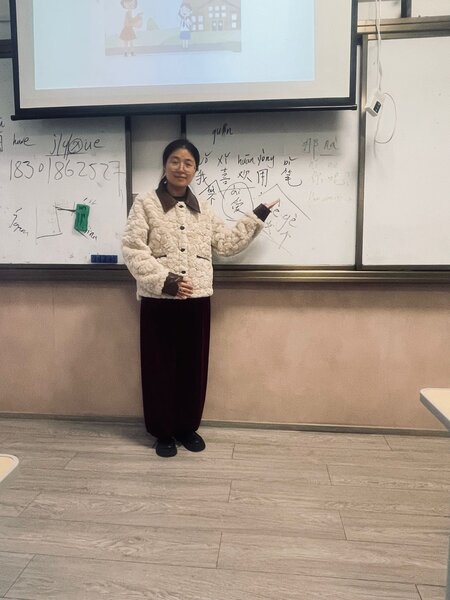
All in all, I am truly happy to be in Romania—a beautiful and friendly country—and I feel honored to have met everyone here. I look forward to learning and growing together with you in class. You are always welcome to join my Chinese classes. Let’s learn and improve together, and become better versions of ourselves.
reporters: RIANA BOGDAN, ALESIA HAȘAȘ


 LOGO paper